Israel's President Gives Gadi Eisenkot 28 Days to Form Government, Challenging Netanyahu
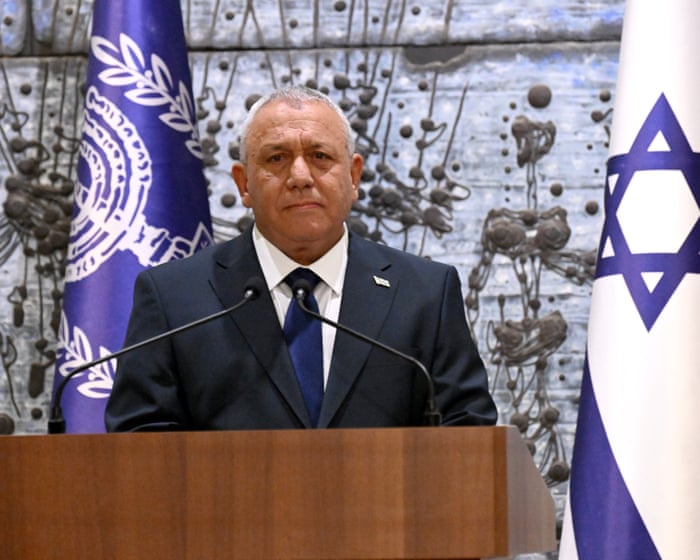 Photo: The Guardian
Israeli President Isaac Herzog formally tasked former military chief Gadi Eisenkot, 66, leader of the Yashar party, with forming Israel's next government on Sunday, giving him 28 days even though his bloc lacks a clear majority. At a ceremony at the presidential office in Jerusalem, Eisenkot said Israel is in a state of emergency approaching a point of no return, said Prime Minister Benjamin Netanyahu had brought the country to a historic crisis, and called for a national emergency government through unconventional political steps. He began reaching out to Netanyahu's allies. His anti-Netanyahu bloc holds 48 of the Knesset's 120 seats, against 53 for Netanyahu's coalition. Arab parties won a record 19 seats and have signaled support, though Eisenkot has not formally allied with them. His options are a power-sharing deal with Netanyahu, Arab-party backing, or an agreement with ultra-Orthodox parties that demand military exemptions. He would be Israel's first Sephardic prime minister.
The New York Post leads with Herzog's choice as a sign of lost confidence in Netanyahu, whose party won the most seats of any bloc. It dwells on the seat arithmetic, the Arab parties' 19 seats and the blow to far-right partners Itamar Ben-Gvir and Bezalel Smotrich, and it dates the nomination to Saturday. The Guardian leads instead with Eisenkot's outreach to Netanyahu's allies and his crisis warning, adds the ICC warrant against Netanyahu and the US Democratic midterm sweep, and sets out the three coalition paths. MS NOW is brief, calling Eisenkot Netanyahu's main rival facing complicated talks. Both sides agree on the 28-day mandate and the lack of a majority. Semafor adds analysts who see little difference between the two men on Palestinians and Iran, plus Trump's and Iran's comments.
How the sides differ Right sources stress seat arithmetic and the Arab parties' role; left sources stress Eisenkot's crisis warning and coalition hurdles; alternative sources add analysts' doubts and Iran talks.
Headline, comparison and summary written by AI from the articles below. AI can make mistakes, so check the original articles before relying on a detail.
- MS NOWIsrael’s president officially taps Eisenkot to form a government
- The New York TimesPaywallWho Is Gadi Eisenkot, Israel’s Opposition Leader?
The Guardian leads with Eisenkot's outreach to Netanyahu's allies and his emergency warning, then lays out coalition options and international isolation. MS NOW briefly calls him Netanyahu's main rival facing complicated negotiations.
- The HinduEisenkot warns of Israel crisis as he seeks to replace Netanyahu’s government
- APIsrael’s president gives Eisenkot the first chance to form the next government
Semafor and The Hindu differ: Semafor cites analysts who see little difference between Eisenkot and Netanyahu on Palestinians and Iran, plus Trump and Iran's comments. The Hindu reports Eisenkot's warning and his potential status as the first Sephardic prime minister.
The New York Post presents the nomination as a sign of lost confidence in Netanyahu despite his party winning the most seats. It stresses seat counts, Arab-party backing and the implications for far-right ministers Ben-Gvir and Smotrich.