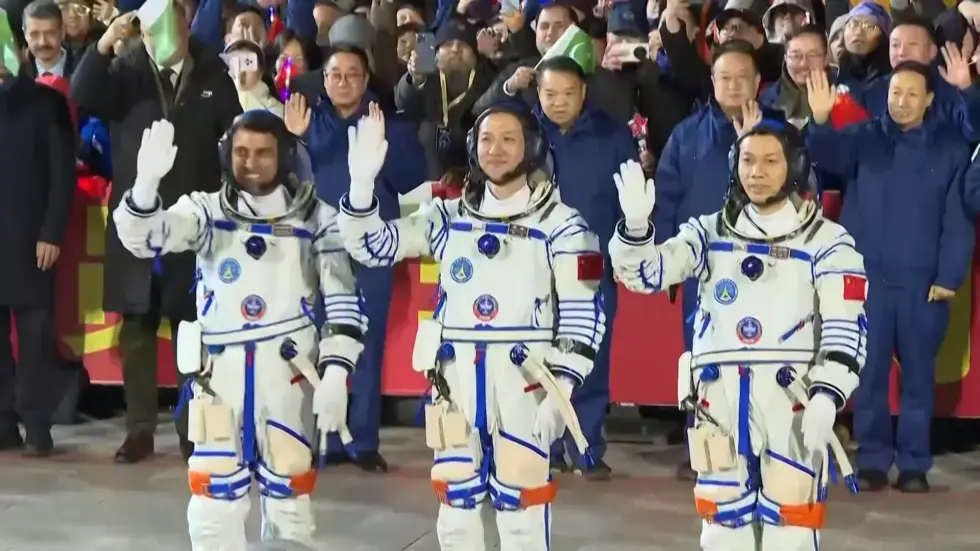
China Launches Shenzhou 24 With First Foreign Astronaut, a Pakistani, to Tiangong Station
China launched the Shenzhou 24 spacecraft on Wednesday carrying Pakistani astronaut Muhammad Zeeshan Ali, making him the first foreign astronaut to reach China's Tiangong space station.
How the sides differ Left sources stress China's global ambitions and the ISS's coming end; independent sources highlight Pakistani culture and Chinese messaging; right sources report launch basics.
Left · 2 sources The GuardianChina sends first foreign astronaut to ISS rival as it globalises space operations1 more source · how they cover it
Both outlets report the launch and its historic first. The Guardian adds the ISS's coming end and an analyst's view; CBS News adds crew details, experiments and Sharif's message.
Independent · 3 sources TRT WorldState mediaButter chicken in zero gravity: China takes halal cuisine beyond stars for Pakistani astronaut2 more sources · how they cover it
- APChina launches Shenzhou 24 spacecraft carrying 2 Chinese and 1 Pakistani astronaut
- The HinduChina launches crewed spaceship carrying first Pakistani astronaut to its space station
TRT World highlights the halal menu, Ali's poetry recital and the foreign ministry's peace-and-cooperation message. Global Times focuses on how China selects astronauts for the mission.
Right NewsmaxChina Launches Shenzhou 24 Spacecraft Carrying 2 Chinese and a Pakistani Astronauthow they cover it
Newsmax reports the launch of Shenzhou 24 with two Chinese astronauts and a Pakistani, and notes it is the first foreign crew member sent to China's station.
China launched the Shenzhou 24 spacecraft on Wednesday carrying Pakistani astronaut Muhammad Zeeshan Ali, making him the first foreign astronaut to reach China's Tiangong space station. It is the first joint flight of Chinese and foreign astronauts in China's manned space program, and Beijing says it will deepen cooperation with other countries. The craft lifted off from the Jiuquan Satellite Launch Center in northwestern China, separated from its rocket and entered its planned orbit. Ali, 40, flies with Chinese astronauts Tang Hongbo, 51, and Wu Yi, 39. Chinese foreign ministry spokesperson Guo Jiakun said: “China's space station is a space station of peace, friendship and cooperation.”
The flight follows an agreement China and Pakistan signed in February 2025. Pakistani Prime Minister Shehbaz Sharif said the friendship was “surpassing the heights of the Himalayas in its journey to outer space.” Tiangong was completed in 2022, and China has invested billions to catch up with the US and Russia. The US-led International Space Station has operated for 25 years and is set to cease operations from 2030, according to Nasa. The crew will carry out more than 90 experiments and tests, Xinhua reported. Ali will run a photosynthetic cyanobacteria experiment and return aboard Shenzhou 23.
Left-leaning outlets place the flight in a larger geopolitical frame. The Guardian presents it as the start of China globalising its space operations while the ISS nears its end, and quotes analyst Blaine Curcio on the scale of the undertaking. CBS News adds crew ages, the experiment plan and Sharif's message. Independent outlets focus on the human and official detail. TRT World describes a halal menu of more than 100 items and Ali reciting a poem, while Global Times looks at how China selects astronauts. Right-leaning Newsmax reports the launch, the crew and the first-foreign-crew-member milestone, without added context in the text available. The outlets agree on the core facts: the date, the crew and the historic first. None contradicts another.
Headline, comparison and summary written by AI from the articles below. AI can make mistakes, so check the original articles before relying on a detail.
How we sort sources into left, independent and right →
Which coverage felt most fair?
One tap. No account needed.