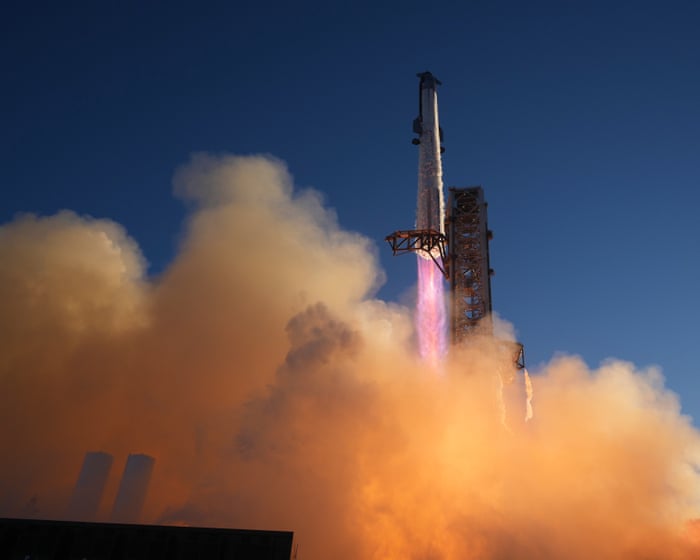
FCC approves SpaceX plan for 1 million orbital data center satellites
The Federal Communications Commission on Wednesday approved SpaceX's request to deploy up to 1 million Starmind satellites that would work as data centers in orbit.
How the sides differ Right sources stress AI leadership and data center backlash; left sources add deployment deadlines and critics' doubts; independent sources highlight Amazon's opposition.
Right · 2 sources Just the NewsFCC backs Elon Musk's plan to build data centers in space1 more source · how they cover it
- Fox Business‘Data centers in space’: FCC clears SpaceX for 1M satellites to ‘extend America’s lead in superintelligence’
Opens with local bans on data centers, then reports the approval through Carr's statements on AI leadership and solar power. Does not include deadlines or critics.
Independent · 3 sources CNBCSpaceX wins FCC approval to deploy 1 million orbital data center satellites2 more sources · how they cover it
- Al JazeeraUS grants SpaceX approval for 1 million space data centres
- The HillFCC approves SpaceX's plan to launch up to 1 million data centers into space
CNBC details Amazon, Viasat and astronomers' petitions, Amazon's criticism and Carr's rebuke, plus Musk's reply. Investing.com, carrying Reuters, lists deadlines and notes it is unclear whether 1 million satellites will launch.
Left · 2 sources The Guardian USTrump administration approves Elon Musk’s plan for datacenters in space1 more source · how they cover it
Reports the approval with Carr's quotes, the deployment schedule and SpaceX's environmental argument. Adds critics who say the technology is still being developed and deployment is distant.
The Federal Communications Commission on Wednesday approved SpaceX's request to deploy up to 1 million Starmind satellites that would work as data centers in orbit. It is the first such authorization in US history, and it sets deadlines for SpaceX to begin deploying them. Under the license, SpaceX must start deployment by November 2033, deploy 10%, or 100,000, by November 2035, and reach 50% by November 2038, the FCC said. FCC Chairman Brendan Carr said the satellites will use solar power to extend America's lead in artificial intelligence. “America is leading the world into the era of super intelligence,” Carr said. Elon Musk replied on X: “This will be a great asset to America and the world.”
SpaceX asked earlier this year for permission to deploy up to 1 million orbital compute modules that would process data for use on Earth. It told the FCC that near-constant solar power would cut costs and reduce the environmental impact of ground-based data centers. Kuiper Systems (Amazon Leo), Viasat and the American Astronomical Society filed petitions to deny the application. Amazon said in March that SpaceX would need centuries to build the constellation, and Carr answered that Amazon should focus on its own deployment shortfall. Only 17,000 satellites exist today, and operators sometimes seek approval for more satellites than they plan to launch.
Just the News, on the right, opens with local bans on data centers over environmental and energy fears. It then presents the approval through Carr's statements on AI leadership and solar power, and it does not mention the deployment deadlines, the petitions or critics. The Guardian, on the left, also quotes Carr but adds the license timeline, SpaceX's environmental argument and critics who say the technology is still being developed and deployment is far off. The independent outlets differ most from each other: CNBC details Amazon's opposition and Carr's rebuke, while Investing.com, carrying Reuters, notes it is unclear whether SpaceX will deploy 1 million satellites. No outlet disputes the core facts. All report that the FCC approved the constellation and that Carr tied it to American AI leadership. The main difference is whether doubts and opposition appear alongside that framing.
Headline, comparison and summary written by AI from the articles below. AI can make mistakes, so check the original articles before relying on a detail.
How we sort sources into left, independent and right →
Which coverage felt most fair?
One tap. No account needed.